
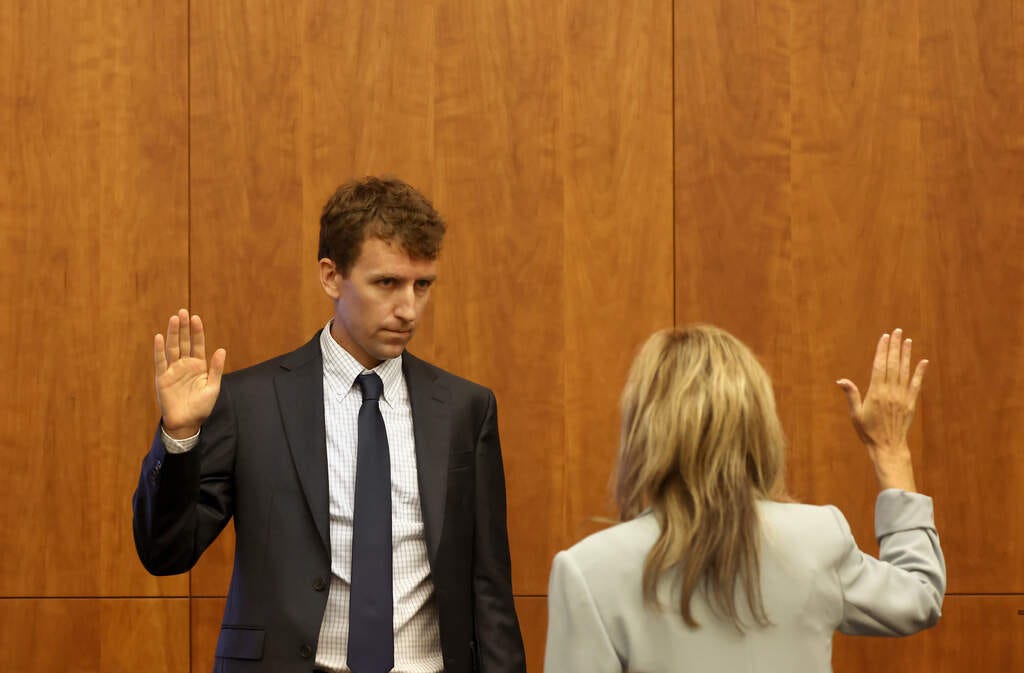
The only thing more striking than the adulation that has erupted in response to Lindsay Clancy’s admitted killing of her three children has been the torrent of anger and suspicion poured out against then-husband Patrick Clancy.
I can’t think of a single example, recent or historical, in which a bereaved mother, her children dead at her ex-husband’s hand, has been subject to anything other than profound sympathy.
It’s not uncommon for such mothers to become revered public figures, campaigning for changes in law or public opinion, and applauded for their “courage” in picking up the pieces of their lives.
One such is Claire Throssell, a British mother whose ex-husband killed their two sons and himself in 2014 by setting their house afire. No one has publicly speculated that Throssell drove her ex-husband to the deed. No one alleged that police should have more closely investigated her actions on the days leading up to the crime.
Throssell, in fact, was centrally involved in a successful feminist campaign to rewrite UK custody law in order to change the presumption that it is generally good for children to have contact with both parents after divorce. The new legislation, not yet formalized, will mean that even fewer divorced fathers will be able to maintain close contact with their children.
An article on Throssell’s role in the campaign pays tribute to Throssell as a loyal mother—not a vengeful or misguided one—and says not a word about the psychological state of her dead ex-husband, Darren Sykes. Readers are not informed whether he was suffering from unmet mental health needs, and most people will not wish to know.
In contrast, nearly everyone is sympathetically interested in Lindsay Clancy’s state of mind. If she is found not criminally responsible for her children’s deaths—or even if she is found responsible—she may well become a popular campaigner for post-partum healthcare, telling the world about what suffering mothers are owed.
A bereaved father is either ignored or placed under suspicion.
Comments on Patrick Clancy’s hours-long testimony at his ex-wife’s murder trial are filled with dislike, speculation, and fulmination, much of it either inaccurate, irrelevant, or both:
Him trying not to yawn the whole time is fkn annoying.
Did he even know his wife ? He️ didn’t know about any therapy sessions. He’s so aloof.
I DONT TRUST THIS GUY!! After such a major tragedy, he was able to recover and married in such a short time!!! I think she would not go through all these complications if he loved her and was supportive!!! He kept making babies knowing her struggles and he talks about it without any emotions! I don’t believe this guy!! I don’t think he was heart-broken about his wife and kids!!!
He drops her off at the psychiatric unit and then goes skiing....wtf
Lindsey’s increasing anxiety, inability to sleep, fear of returning to work ... ALL SIGNS OF NARCISSISTIC ABUSE.
There are many more like this, diagnosing Patrick’s state of mind or condemning his inadequacies, expressing disgust at his decision to divorce his murderous wife, and even more at his remarriage. At best, he is a cipher in a suit, an unsympathetic man who failed to love his wife as she deserved. At worst, he is an ice-cold monster who was likely having an affair while his wife was sick.

In the Greek myth of Jason and Medea, Medea the sorceress kills their two sons after Jason is unfaithful to her. The myth holds Jason at least partially responsible for Medea’s filicide because he repaid her loyalty with selfishness.
In the myth, Medea escapes with her sons’ bodies in a golden chariot, thus showing the favor of the gods, while Jason is disgraced and exiled from power, having brought his sons’ deaths—and his own humiliating demise (he is crushed to death by a piece of his ship)—upon himself. The myth is usually read as a warning about the consequences of male betrayal, not as a depiction of potential female viciousness.
Feminists have, unsurprisingly, interpreted Medea positively as a figure of liberatory resistance against patriarchal injustice. Her ruthlessness is fully justified because Jason failed her.
As if unconsciously following the Greek mythic script, Patrick’s detractors see him as having betrayed Lindsay. To them, he is an ogre who forced a mentally ill woman to return to work before she was ready, or who deliberately ignored her confession that she was having thoughts of harming the children.
Some go so far as to allege that he is the true killer, having strangled the children while pretending to be out of the house and then throwing his drugged wife out the window, informing her afterwards in his “male” voice, as she lay crippled in the snow, that she was the one to blame:
Cold as ice. Absolutely zero emotion. Chilling. He did it. A true psychopath. He dropped her off to get admitted then takes his kid skiing?! WTH??? Didn’t know where their bed was located in the room? Unreal. How could they not investigate him? Just terrible.
These critics also attack Patrick personally, calling out his dead eyes, lack of affect, and alleged sociopathy. Many have made him into a stand-in for the failure of all husbands to protect and care for their (always suffering) wives:
This “husband” doesn’t even realize that even when his wife was in the middle of postpartum depression SHE was still planning and trying to “show up”/ masking to make others feel comfortable... he doesn’t even know if they went to pick out a Christmas tree but supposes cause obviously she was the one making sure her children had memories.... MEN need to be better husbands!
It doesn’t matter to Patrick’s accusers that police and the defense team had years to investigate every aspect of his alibi and past life, and found nothing against him. All of the contradictory claims of the amateur sleuths are ultimately beside the point because the animus is the point, deep-rooted, archetypal, perhaps irresolvable. The man must be held responsible, and his innocent pathos is repugnant because it is an emblem of masculine impotence. As one commenter put it, pithily and unfairly:
She told him she was gonna hurt them and he didn’t protect them. Period.
This is the nub of the matter, the impossible paradox of modern manhood that leaves men like Patrick Clancy accused, powerless, hated, and unmourned.
Lindsay could have destroyed him in any of the more usual ways that women regularly destroy men, and he would have been equally blamed and/or ignored.
The fact is that even if Patrick had known that his wife was going to kill their children, he couldn’t have prevented it. At some point, he would have had to leave the house. He couldn’t keep her under watch. He couldn’t have her hospitalized if she didn’t wish it. He couldn’t have divorced her and taken the children, even if she had had a more worrisome psychiatric history than she had.
All he could do was what he did, believing his wife when she said she was feeling better, and then howl out his grief to the equally impotent authorities he called after discovering her monstrous act.
His failure is sickening because many of us recognize in it a paradigm of our female-dominated world, in which men are a prey to crazy women, unable to protect themselves or innocents. They are unable to restore our society or to set boundaries against the dangerous and the ill.
Every man is under sentence at marriage. No matter how he may try to test and assess beforehand, every man can find himself trapped.
Most do not end up with their children murdered, but many have them judicially stolen through divorce; many have their lives upended through false accusations; many suffer in silence while trapped with intolerable abuse.
Some of us are angry precisely because Patrick is not angry. He has made it clear that he believes that Lindsay was not criminally responsible for killing their children: “I wasn’t married to a monster—I was married to someone who got sick,” he told a feature writer for The New Yorker.
He is disturbed by the possibility that she might have deliberately sent him out so that she could kill their children, but he sees no point in dwelling on the thought.
Like many men, he seems to harbor no ill will toward the destroyer of his children, only sadness. In that, too, he seems a symbol of the too-compassionate compliance of many men today.
The vitriol against Patrick Clancy is possibly even more sickening than the pink-shirted support for his murderous ex-wife.
The one upside to this horror show is that people are seeing and discussing the foundational contradictions of feminism.
This episode is another example of the staggering power that women have over men.
In the face of that power, many men do in fact feel powerless, since the cultural presumption is that women are always right and men are always wrong.
I have fortunately not encountered women as dangerous as Clancy but I do bear the scars of encounters with women who felt justified in using any means to get what they wanted.
They have weaponized their claimed victim hood, giving them a sword and shield they world against anyone in their path.