

Following her death last Wednesday at age 92, Gloria Steinem has been described as “a woman who mattered,” “a feminist icon,” and even “the personification of the women’s movement.”
Here, I look at some of Steinem’s early essays (1962-82) outlining her views.
Steinem gained national attention for her writing in the same year, 1963, that Betty Friedan published The Feminine Mystique, which allegedly unveiled the miseries of women trapped in suburban domesticity. In time, Friedan drew back from the anti-male and anti-child intransigence of the movement she had inspired, but Steinem never did, becoming one of its most appealing representatives. With her golden good looks and svelte, fashionable appeal, she seemed to promise a “new and compassionate kind of power” in America (“Introduction,” Outrageous Acts and Everyday Rebellions, p. 30).
The “real definition” of feminism, she assured her supporters, was simply the recognition of “the equality and full humanity of women and men” (Outrageous Acts, p. 3).
Yet all of Steinem’s positions were, in fact, radical, including the contention in her first major piece of feminist journalism that women across America were being sexually objectified and dehumanized by men. This contention was central to her story about the young women who found work at Hugh Hefner’s Playboy Club in New York City, one of a number of such clubs that Hefner marketed to middle-aged businessmen wanting to be served drinks by pretty girls in tight outfits and bunny ears.
Seeing an opportunity for a titillating investigation, Steinem took the name Marie Catherine Ochs and subtracted four years from her age to become a 24-year-old server at the Playboy Club, a position she occupied for close to three weeks. The resulting exposé was published as “A Bunny’s Tale,” (retitled later by Steinem as “I Was a Playboy Bunny”), a long double feature for the May and June, 1963 issues of Show magazine.

Steinem had clearly hoped, and expected, to discover horrors at the Playboy Club: women pressured to have sex with club members, women verbally abused and shabbily treated by crude, contemptuous men. The article was set up to mock and revile Hefner’s establishment.
In fact, Steinem’s experience at the Playboy Club was quite mundane. The work was highly regulated, as one would expect from a position in which image was everything, and the shifts were tiring: long hours spent on painful, swelling feet in a too-tight outfit, regulation 3-inch heels, and a stuffed bodice.
But there was no sex with club members—they weren’t allowed even to touch the servers—and aside from offers of dates from the mostly paunchy and balding men who came to the club, there was nothing at all unpleasant. The pay was not quite as good as advertised, and there were demerit points for having a tear in one’s stockings or a bedraggled puff tail, but the worst that could be said of the job was that it was no more glamorous than waitressing.
Nevertheless, Steinem wrote as if there were horrors, telling readers how dehumanizing it was, for example, to have to memorize scripted phrases (“Good evening, sir, I am your Bunny, Marie. May I see the member’s key, please?” and so on). This became her running theme in “I Was a Playboy Bunny”: that the Bunnies were treated as objects little better than prostitutes. One evening while working in the coat check, she noted that “There were a few customers, a very few […] who looked at us not as objects but […] as if we might be human beings” (Outrageous Acts, p. 58).
Then, while walking home one night, Steinem purportedly exchanged a glance with a prostitute she passed on the street, noting that “Of the two of us, she seemed the more honest” (Outrageous Acts, p. 59). The self-pity was nestled behind the allegedly searing insight into women’s degraded lives.
Ultimately, what Steinem decided to emphasize about the story—and the meaning accepted ever since—was that the techniques taught and interactions between male club members and female servers were typical of relationships between men and women in general. As she said in her conclusion, she came to the realization that “all women are Bunnies,” i.e., all women are taught to please men, given lines to learn, tutored to make men feel listened to, wear degrading outfits, and are essentially no more than props to male self-esteem.
This was a classic feminist rhetorical move: to take the experiences of one group of women, paint them as entirely negative, and then claim that they were representative of all women’s (oppressive) experiences.
That they weren’t the reality of Steinem’s own (independent, well-educated, and intellectually ambitious) life mattered not at all. It also didn’t matter that men came to the Playboy Club precisely because the club offered a fantasy that was different from the rest of the men’s humdrum lives, in which they were mostly undesired and un-titillated—not sexually powerful or commanding.
Offered as a candid snapshot of all women’s reality, the article was actually a piece of poor-me propaganda as deliberately fabricated as the Bunnies’ costumes.
Steinem went on to have a long public career as America’s most photogenic feminist, founder of Ms. magazine and the public face of causes ranging from equal pay to the Hillary Clinton presidency. In the pages of Ms., she showcased feminism’s anti-family and anti-civilizational agenda. Credited with popularizing the feminist slogan “A woman without a man is like a fish without a bicycle,” she encouraged American women to misunderstand the reality of their lives.
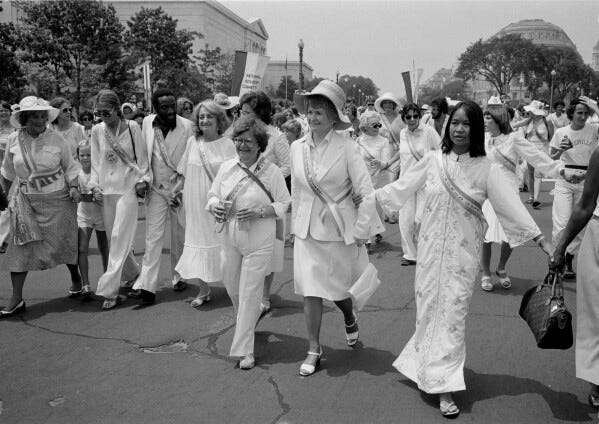
Like all radical feminists, Steinem portrayed the history of the United States as a patriarchal plot designed by powerful white men to control women and racial minorities for white men’s profit and pleasure. Differences between men’s and women’s roles, she maintained in her 1972 essay “Sisterhood,” were cultural rather than natural, engineered by men to turn women into an inferior class. She claimed this simplistic view of the world as “a revelation, as if [she] had left a dark room and walked into the sun”:
“Women are human beings first, with minor differences from men that apply largely to the single act of reproduction. We share the dreams, capabilities, and weaknesses of all human beings, but our occasional pregnancies and other visible differences have been used—even more pervasively, if less brutally, than racial differences have been used—to create an ‘inferior’ group and an elaborate division of labor. The division is continued for a clear if often unconscious reason: the economic and social profit of males as a group” (Outrageous Acts, p. 128).
Men, in Steinem’s writing, were often obtuse and destructive. At best, they simply did not understand—or were uninterested in understanding—women’s legitimate dissatisfactions and frustrations. She noted that “when we’re exhausted from dredging up facts and arguments for the men whom we had previously thought advanced and intelligent, we make another simple discovery: women understand” (Outrageous Acts, p. 129). Of course they did. Steinem never considered that there was anything in men’s lives that she and her feminist friends did not understand, that men too had sources of suffering that undermined their imposed identities as so-called privileged oppressors.
As a child of divorce, Steinem had no positive view of marriage or family formation. She blamed her father in large part for her mother’s nervous breakdown and subsequent decades of mental illness. If her mother could have left her father without fear of shame and stigma, Steinem alleged in her 1983 “Ruth’s Song (Because She Could Not Sing It),” she might have had a normal, happy life. Steinem thus came to see the nuclear family as a primary site of female oppression:
“I began to think about the many pressures that might have led up to that first nervous breakdown: leaving my sister whom she loved very much with a grandmother whose values my mother didn’t share; trying to hold on to a job she loved but was being asked to leave by her husband; wanting very much to go with a woman friend to pursue their own dreams in New York; falling in love with a co-worker at the newspaper who frightened her by being more sexually attractive, more supportive of her work than my father, and perhaps the man she should have married” (Outrageous Acts, p. 155).
Steinem came to identify with her mother’s discontent so profoundly that she imagined her mother better off not only without her father but even without the daughter, Gloria, who had kept her trapped in her situation:
“At the hospital and later when Ruth told me stories of her past, I used to say, ‘But why didn’t you leave? Why didn’t you take the job? Why didn’t you marry the other man?’ She would always insist it didn’t matter, she was lucky to have my sister and me. If I pressed hard enough, she would add, “If I’d left, you never would have been born.’
I always thought but never had the courage to say: But you might have been born instead” (Outrageous Acts, p. 157).
A woman who believes that her birth destroyed her mother’s life by keeping her tied to her father is a woman who will celebrate the destruction of unborn life and the dissolution of the marriage bond.

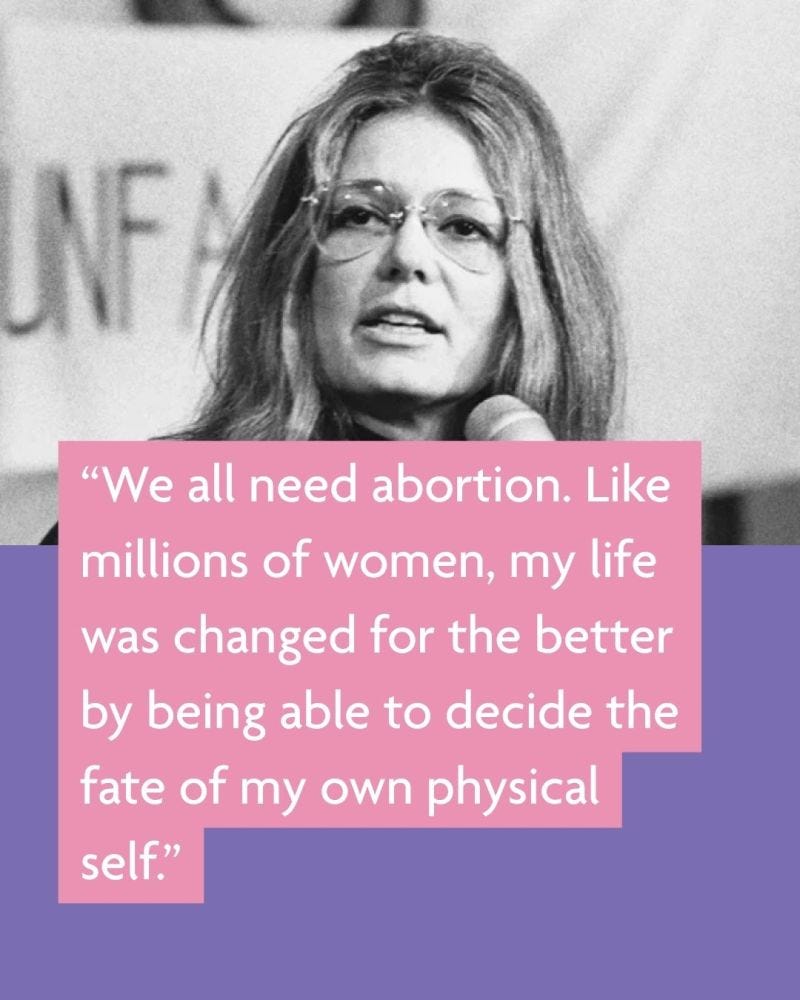
Perhaps naturally, then, Steinem became a radical abortion advocate. Without abortion, she believed, there could never be true freedom for women. Without abortion, there would always be commitments and responsibilities that mattered more than women’s autonomy. Describing a meeting in which women told of their experiences with illegal abortions, she exaggerated the number of women who said they had had one in order to declare abortion necessary and good:
“Suddenly, I was no longer learning intellectually what was wrong. I knew. I had had an abortion when I was newly out of college, and had told no one. If one in three or four adult women shares this experience, why should each of us be made to feel criminal and alone? How much power would we ever have if we had no power over the fate of our own bodies?” (Outrageous Acts, p. 20).
If many women were doing something, Steinem reasoned, it couldn’t be wrong. This became the nub of Steinem’s philosophy: nothing must impinge on women’s freedom, certainly not moral reflection or biological fact. As she discussed in her 1979 essay “Words and Change,” it thus became necessary to change language in order to normalize feminism’s assault on traditional values. She wrote at length about how the phrase “reproductive freedom” profoundly shifted the terms of discussion, allowing feminists to frame the killing of unborn babies as “a universal human right at least as basic as freedom of speech or assembly” (Outrageous Acts, p. 173). She was enthusiastic, too, about the replacing of “pro-abortion” with “pro-choice” to signal a positive abstraction rather than a surgical procedure. One can only speculate what Steinem would have had to say about the Lindsay Clancy affair and the many women testifying to their murderous fantasies.
Ultimately, Steinem adopted and promoted all the primary values of utopian progressivism, including hatred of America as a white supremacist power and the imputation of superior cultural values to non-western peoples.
In a 1979 essay written with Robin Morgan on international efforts to stop female genital mutilation in Africa, this advocate of sexual liberation was anxious to show her solidarity with anti-colonial resistance even when that meant aligning herself philosophically with proponents of FGM:
“The situation is further complicated by the understandable suspicion on the part of many African and Arab governments and individuals that Western interest in the matter is motivated not by humanitarian concerns but by a racist or neocolonialist desire to eradicate indigenous cultures. In fact, as Jomo Kenyatta, Kenya’s first president, noted in his book, Facing Mount Kenya, the key mobilization of many forces for Kenyan independence from the British was in direct response to attempts by Church of Scotland missionaries in 1929 to suppress clitoridectomy” (Outrageous Acts, p. 336-337).
Steinem here was quick to declare her sympathy with Kenyan nationalists’ “understandable suspicion” of the allegedly “racist” and “neocolonialist” efforts of those Christian missionaries who objected to the practice of cutting off girls’ clitorises. She was willing to accept that the (white) missionaries were unlikely to have been acting in good faith or out of genuine humanitarianism. Clearly, Steinem and Morgan could occasionally side with men—even when those men were opposed to their women’s sexual pleasure—when it allowed her to castigate white colonial arrogance.
Her anti-white positioning was given further expression in a 1982 essay on black American novelist Alice Walker when she admiringly quoted Walker’s statement that “Since white men lived by raping the earth and then by threatening us all with the bomb—why not let them die by it?” (Outrageous Acts, p. 307). Steinem ended the article by assuring readers that “I think we can trust Alice Walker to know us. And we can change for the better if we know her” (p. 310). Genocidal rage against white men appeared to mix seamlessly with Steinem’s other feminist values.
Despite her modern style and reassuring demeanor, there was nothing “compassionate” or humane about Steinem’s vision. Rooted in revolutionary cant about men objectifying women, and dedicated to the subversion of marriage and motherhood, it was socially and culturally poisonous. Perhaps more than any other feminist leader, Steinem promised liberation and fulfillment for both men and women while delivering the sterile narcissism of today’s feminist culture.
Thank you Janice for this honest take on the actual workings/writings of Steinem. i had not been aware of her White supremacy ideas and her anti-American take on things. It figures though.
"Steinem never considered that there was anything in men’s lives that she and her feminist friends did not understand, that men too had sources of suffering that undermined their imposed identities as so-called privileged oppressors."
This is such an important indictment of both Steinem and of feminism. Obsessed with themselves to such a degree they fail to have compassion for anyone else.
When I worked as an Employment Manager in the 1970’s in a Community Health Center I interviewed a Clinical Psychologist who worked for Hefner. Hefner had expressed to her his concern that the models in his employ relied too much on their physical attributes and had too little appreciation for their intellectual capabilities. Her job was to counsel them on recognizing and developing these other capacities as that would serve their longer term benefit. What an ogre!