Chivalry’s Last Stand
A male feminist rides to women’s rescue with inaccurate data and a plan for other men’s money


“I have written before about the need for male accountability. I have said plainly that you do not get a cookie for not being a rapist—that basic human decency is the floor, not an achievement.
Because this is not sustainable. And the cost of our collective inaction is being paid, every single day, in the bodies, safety, and freedom of women and girls.”
--Qasim Rashid, Esq.
**
I’ve read a lot of male-bashing twaddle in my time, but nothing quite so audacious as Qasim Rashid’s recent screed on Substack, “Women Are Not Safe Around Men.” Here the author, a Pakistani-born American activist, attorney, and would-be Democratic congressman, argues in a widely-read essay that it is finally time to confront the fact that men are responsible for violence, and that only a prolonged period of taxpayer-funded “restitution” can begin to make things right. Women, he emphasizes, are not responsible for violence.
Keen as he is to tell everyone how very bad men are, Rashid seems willing to bend the truth to do it. In fact, his essay not only bends but repeatedly mangles, pummels, and pulverizes truth, all the while assuring readers that what he is presenting is merely “a documented, data-driven, legally and empirically supported fact.”
He claims that “The data is unambiguous and the solutions exist. The only thing missing is the will to act.” He promises to “lay out the full scope of this crisis, dismantle the myths that protect it, and propose the concrete solutions that could actually end it.” Under Rashid’s blueprint for social justice, men and boys will be properly shamed and brought low before women, forced to accept blame for the harms they have allegedly caused (over centuries), and made to foot the bill for a thoroughgoing, nation-wide program of feminist recompense.
To this end, Rashid lists a panoply of government-funded perquisites for women, ranging from free tampons and abortions to girls-only public schools, tax-free status for 40 years of their adulthood, free college tuition, yet more DEI hiring and promotion, and mountains more funding for feminist propaganda about male violence and female innocence. Women’s status as preferred citizens will be indelibly etched into American law and policy.
Any man who thinks of objecting—raising questions about male victims or male self-sacrifice—is instructed by Rashid to “get therapy” and stop “protecting predators.” He accuses men, “It is absolutely, unequivocally, entirely your problem.” Women, of course, come in for no such judgement. “At no point have I asked women to do better,” he boasts. “Women are not the problem.”

Well. Except when they are. Just last week, a Long Island woman slit a man’s throat while he was sleeping next to her at his parents’ home, causing him to bleed to death. A month before that, a Wisconsin woman (above) stabbed her boyfriend to death over an argument about dinner; she told police he had been “pushing her buttons.” In the same month, a woman in Arizona is charged with running over a man with her car, killing him after he tried to leave their date early. A few months before that, a Minnesota woman confessed to killing her boyfriend with a knife because he wouldn’t have sex with her. Rashid does not include these and other acts in his outcry against gendered atrocity.

But even if women were far more peaceable than they are (and more on this point later), Rashid’s central argument—that men as a group owe women recompense for a minority of men’s violence—would still be spurious. “I have said plainly that you do not get a cookie for not being a rapist,” Rashid sneers as he predicts the typical male response. “The men who rush to announce their personal non-violence the moment this conversation begins,” he alleges, “are doing exactly what this culture trained them to do—center themselves rather than confront the problem.”
Wrong. They’re responding to your false allegation. While it’s true that men cannot and generally do not expect praise for non-criminal behavior, they do have a moral right not to be blamed, discriminated against, insulted, and forced to pay for crimes they did not commit and which they are powerless to prevent. Rashid is engaging in repugnant scapegoating and collective punishment—and in most other contexts (Muslim terrorism? black crime?), I’m pretty sure he would recognize it as such. But his interest in human dignity and justice seem to dry up when it comes to blaming men as a group. He even proposes that little boys should be forced to take “consent classes” in school from “the earliest grades” so that they can learn of their inherited guilt.
Rashid’s contention that men are complicit in violence because they do not speak against it is unproven and unprovable, though heavy with feminist rectitude. “Male violence does not survive without male silence,” he recites glibly. This is pure bombast. The assumption seems to be that if enough men don their hair shirts, denouncing other men and ceding power to women with sufficient enthusiasm, violence will dramatically diminish. But such a belief profoundly misrepresents the reality of violence, including women’s central role in it.

Facts Are Not Safe with Qasim Rashid
In reality, Rashid’s thesis is not “a documented, data-driven, legally and empirically supported fact” but a cornucopia of exaggerations, half-truths, and outright misrepresentations far too numerous to cover here. For example, he twice mentions sixteen-year-old Timothy Hudson, who has been charged with the rape and murder of his stepsister, Anna Kepner, on a cruise ship last November. Rashid offers Kepner’s murder as dramatic evidence that “Women are not safe around men.” In fact, sibling and step-sibling homicides are extremely rare, providing scant backing for his anti-male tract.
What would Rashid say about the case, just a few years ago, of a nine-year-old boy who was stabbed to death by his twelve-year-old sister? Surely the boy cannot be made out the victimizer in the incident? Or why not refer to the indictment, last month, of a sixteen-year-old girl for the murders of her two parents and grandmother in order to claim that parents are not safe around their daughters?
“Women are Not Safe Around Men” is consistently weakened by similar lapses in logic and accuracy. Early on in the essay, Rashid asserts that the Laken Riley Act, which authorized mandatory detention for illegal immigrants charged with crimes—signed into law after a young woman jogging at the University of Georgia was murdered by a Venezuelan illegal—not only fails to protect women but “likely puts women in even more danger.” Come again? Rashid makes no attempt to defend this piece of bluster.

He also claims that encouraging women to protect themselves with a gun will leave them worse off than ever. He links to an anti-gun article allegedly proving that “when a firearm is present in a domestic violence situation, a woman is 100 times more likely to be killed by that firearm than to successfully use it in self-defense.” The article does not show what Rashid claims—it counts all gun murders of women, not only domestic homicides, and certainly doesn’t show that women are being killed by their own guns, as his statement suggests—but even if Rashid had been able to paraphrase the article accurately, it would prove nothing about the usefulness for women of owning and knowing how to use a gun in self-defense.
But these are relatively minor inaccuracies. Rashid’s central claim about women and men is far more outrageous. In order to make a sweeping assertion about “male violence,” Rashid draws catastrophizing conclusions from two main sources, neither of which proves what he presents it as proving.
The first is the WHO report on violence against women, which shows, according to Rashid, that “one in three women, at minimum, report experiencing sexual assault or rape by men.” In fact, the report “estimates” that 30% (3 in 10, not 1 in 3) of women worlwide have experienced “either physical and/or sexual” violence, “in their lifetime.” Moreover, the WHO’s “estimate” is impossible to take seriously.
Like the now-infamous Mary Koss survey that counted women as rape victims even when they themselves did not consider that they had been raped, the WHO report defines “violence” so broadly as to make the word virtually meaningless. The WHO website’s definition of intimate partner violence, for example, includes non-physical and highly subjective phenomena such as “psychological abuse and controlling behavior.” Sexual violence is also defined with extraordinary elasticity to include any unwanted “sexual act” or “attempt to obtain a sexual act” as well as any “unwanted sexual touching and other non-contact forms.”
When nearly any “act” at all, even one that does not involve touching or that merely constitutes an “attempt” at touching, can be classified as violence or sexual violence, the wonder is that well over 2/3 of women (70%!) have said they never experienced any of it. Even squinting one’s eyes as hard as Rashid invites us to do, it is impossible to see the survey results as proving a “crisis” of violence against women.
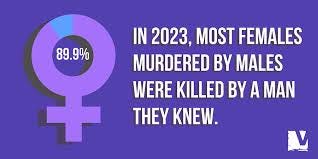
The other source is presumably less open to interpretation: government data on homicides—yet Rashid’s use of it is irresponsible and misleading. Rather than looking at the Bureau of Justice statistics himself, Rashid quotes from a feminist source, When Men Murder Women, that draws on the statistics to focus exclusively on women’s murders. Rashid makes much of the (quite unremarkable) fact that most women are killed by people they know. Yes, conflict can lead to violence, and the type of conflict in which women are most likely to be involved is domestic conflict. Men, in contrast, are vulnerable in a larger variety of settings, including domestic and public ones. Men’s homicide victimization rate is over three times that of women, but of course Rashid makes no mention of this fact.
Like all feminists, and consistent with the inflammatory report he cites, Rashid would have us believe that only women are killed in domestic violence incidents. This feminist canard has been repeated so often over the past 50 years that many people accept it unthinkingly. But the actual data tell a different story. In the year 2023, the year covered by the report Rashid cites, there were 1,560 women in America killed by their intimate partners. This is a sad and concerning number, certainly.
But in the same year, there were 896 men killed by their intimate partners, making men 36% of all intimate partner homicides in that year. Overall, there were 15,440 murders of men, whether by strangers, acquaintances, family members, or intimate partners, compared to 4,360 murders of women.
Why are the murders of women a national tragedy not only to be publicly acknowledged but also universally atoned for through men’s ritualized shame and forced restitution, while the murders of men—in significant numbers at women’s hands—are not worth even a mention?
We know why.
In a 2009 meta-study (“Gender symmetry in partner violence,”) American sociologist Murray Strauss debunked decades of feminist mythmaking about intimate partner violence, showing that most such violence was mutual, with women hitting, punching, and shoving as much or more than men (p. 2). (The US Center for Disease Control and the UK-based ManKind Initiative have also consistently found a high prevalence of intimate partner violence against men.) Murray included research showing that an important predictor of whether a woman would suffer abuse from her intimate partner was whether she herself engaged in violence, for “female use of aggression is an important precipitant of male aggression” (p. 15). This common-sense explanation is one that most feminists, including Rashid himself, are highly unlikely to mention as it detracts from the emphasis on helpless female innocence. Murray also found that only a minority of female violence against their intimate partners was defensive in nature (p. 5).
While Rashid makes much of the claim that many experiences of violence are not reported by female victims, he should know from one of his own favored sources, RAINN (the Rape, Abuse & Incest National Network), that it is men, not women, who are less likely to report abuse. Therefore, estimates of men’s and boys’ experiences of victimization are particularly inadequate; unfortunately, feminist opinion-makers like Rashid have a vested interest in downplaying men’s suffering in order to maintain the fiction of exclusive male culpability.
Are children safe around women?

On the subject of female culpability, one can find gruesome examples aplenty, particularly when it comes to the abuse and killing of children, about which Rashid has nothing to say. Thus his essay avoids the case of the twelve-year-old Ontario boy who was murdered by his two foster mothers, a lesbian couple who confined, tortured, and starved the boy for years while expressing their hatred and resentment of him in text messages to each other.
Has Rashid heard about the Georgia woman who, last fall, beat to death a four-year-old girl in her care, concealing the little girl’s body in the trunk of her car after she was dead? The autopsy revealed a multitude of bruises, lacerations, and scars, evidence of fresh violence and dozens of past injuries.
Was Rashid outraged after an Atlanta woman killed her boyfriend’s toddler son by fracturing his skull, having written to a friend about the boy, “He hates me, and I hate him.”

What are Rashid’s thoughts, if he has any, about the Long Island woman who, along with her adult daughter and mother, was charged with the months-long torture and murder of a seven-year-old girl in her care? The girl’s body had approximately 90 injuries following months of abuse documented by the three women.
How will shaming men and empowering women help the children and babies who are beaten, abused, and murdered by their mothers or other female predators?
To use Rashid’s words, these are documented cases. The data make clear that women are the primary killers and abusers of children. A US government report for the year 2023 (Child Maltreatment 2023, US Department of Health and Human Services) shows mothers as by far the most frequent perpetrators of child fatalities (p. 65).
Moreover, there is some evidence that male sexual violence is linked not to male power or cultural narratives about masculinity but to childhood sexual abuse by a female relative. Are these female abusers the women who are entitled to taxpayer-funded restitution and privileges? Are these the women who do not need “to do better”?
And this is not to mention the multitude of cases of female teachers recently convicted of sexual assault of the boys (and some girls) in their care, some as young as twelve and thirteen years old (see, for example, this New Jersey teacher who sexually assaulted two 14-year-old boys at her school and then aborted the baby she conceived with one of them). I have written on the subject here.
Let’s Stop Denying the Decency of Many Men and the Evil of Some Women
The simple truth, contrary to Rashid’s puerile proclamation, is that both sexes have the capacity to abuse, and it is dishonest to claim that only men constitute a danger and that all of society should be organized around a false narrative of male perfidy and female innocence. Men’s anger and disgust, where it exists, is perfectly justified in the face of the hateful disinformation being spread by Rashid.
It’s not possible to say why Rashid prefers his false narrative. Conviction of moral superiority is a powerful drug. So is the power that feminist posturing brings. Perhaps Rashid glories in the image of himself as the one good man, the man who holds other men accountable and refuses to be silent. Whatever his motive, Rashid’s willingness to caper on the feminist stage, adopting feminist falsehoods and declaiming against men, makes for an absurd, disgusting performance.
Excellent commentary.
Perhaps he is trying to atone for - or distract our attention away from - the horrific gang rapes of white girls by Pakistani immigrants in the UK? Showing his ‘loyalty’ to the Pakistani community??
This bout ends by way of a devastating first-round knockout! Fiamengo prevails yet again!
Well done Janice. Thanks so much for the huge effort to refute this pack of intentional deceit. I gritted my teeth and looked at the comments to this piece and it told quite a story. Nearly all of the comments were lavish praise for this good boy who loved women. I think that tells the story of why he would be so crooked. They ate it up.