Why Does Feminism Want Women Fat?
Academics and advocates have been hiding the truth about obesity for decades

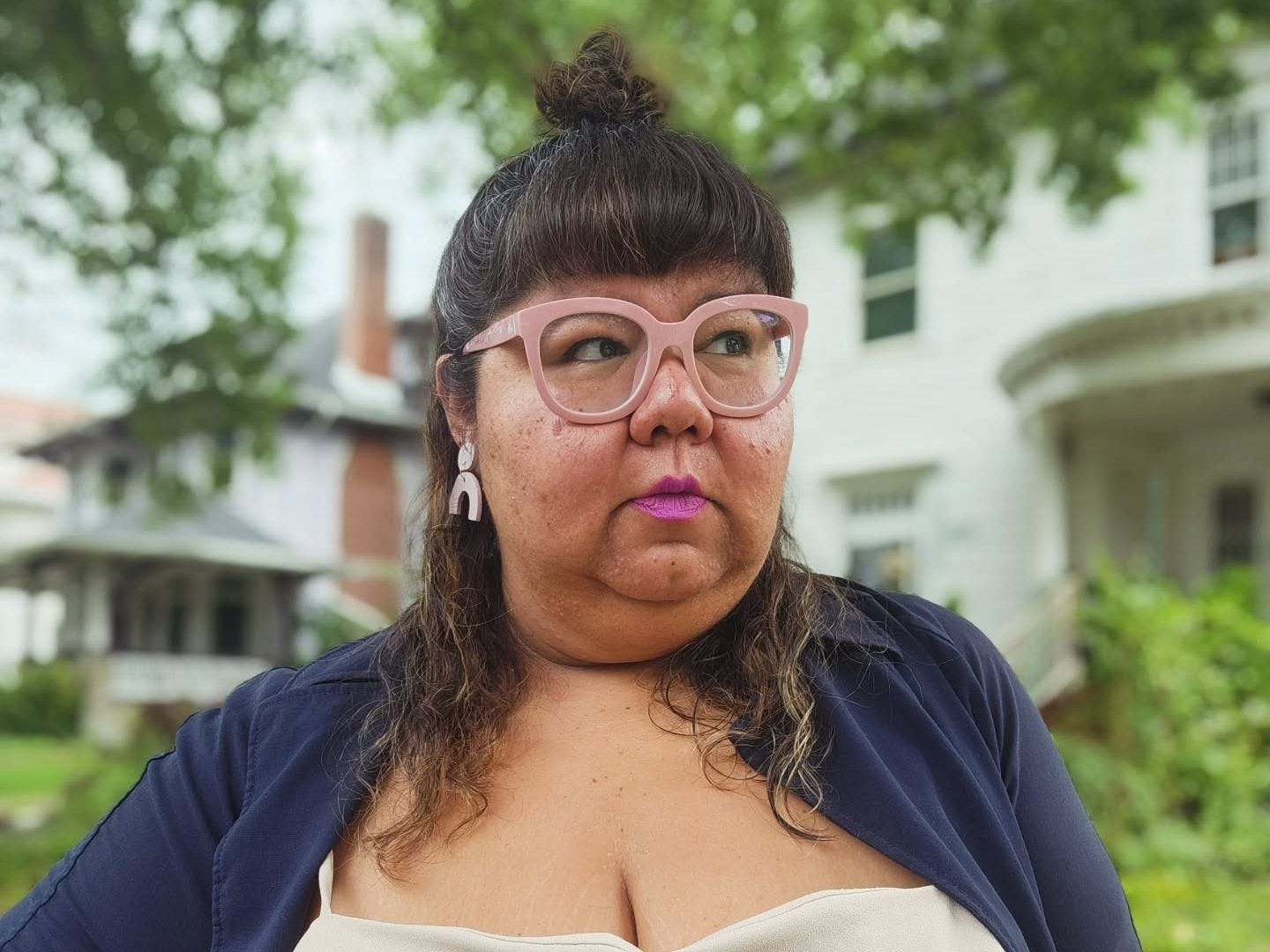
Some feminists want to see more fat women in movies, advertising, and on the fashion runway.
Writing for Vox magazine in late 2023, culture correspondent Constance Grady expressed her dismay at Hollywood’s embrace of Ozempic and other weight loss drugs. Grady opposed Ozempic not primarily because it is a new drug whose long-term side-effects are unknown (though she does mention this concern), but because it exposes the hollowness of Hollywood’s seeming embrace of body positivity. After a short surge in proclaimed fat acceptance, Grady laments, thin has returned with a vengeance: “Plus-size models vanished from the runways.”
It turns out that Hollywood elites, along with most of the rest of us, don’t like fat and would rather be rid of it. Large-size Lizzo lost the lbs.
All the propaganda in the world instructing fat women to accept and even defiantly celebrate their adipose tissue has not significantly changed the cultural consensus; it has merely increased the number of obese women.
Grady, of course, puts a sinister feminist spin on the matter, concluding that “Ozempic seems to give our body-fascist culture permission to say the quiet part out loud […] Your body is not enough, you should hate your body […].”
Grady has created a false dilemma. Hating one’s (fat) body or hating oneself are not women’s only options. There is the possibility of rational acceptance, positive action, and wholesome self-restraint.
We can admit without self-loathing or scapegoating that it is better for the average woman to weigh 135 lbs than 215 lbs. We can recognize that obesity is “indisputably” associated with serious health problems that include infertility, pregnancy risks, cancers, diabetes, and heart disease.
We can recognize that it is better to combat compulsive eating with self-mastery; and better to find joy outside the self than to gorge on gooey desserts.
We can even admit that eating to extreme fulness is a self-defeating pleasure.
Grady’s exaggerated framing of the issue raises the question of why so many feminists are preoccupied with celebrating obesity.
Despite what fat acceptance says, the issue has never been about “acceptance.” It has been about pretending that being a fat woman is just as desirable as being a slim woman, and that rolls of puckered, sweaty adipose are at least as attractive as shapely, slim limbs.
Worse, it has involved pretending that nothing can be done about obesity and that obesity’s health consequences can and should be protested or legislated away.
Feminism wants to make and keep women fat. Why?
Beauty Standards and other Patriarchal Plots
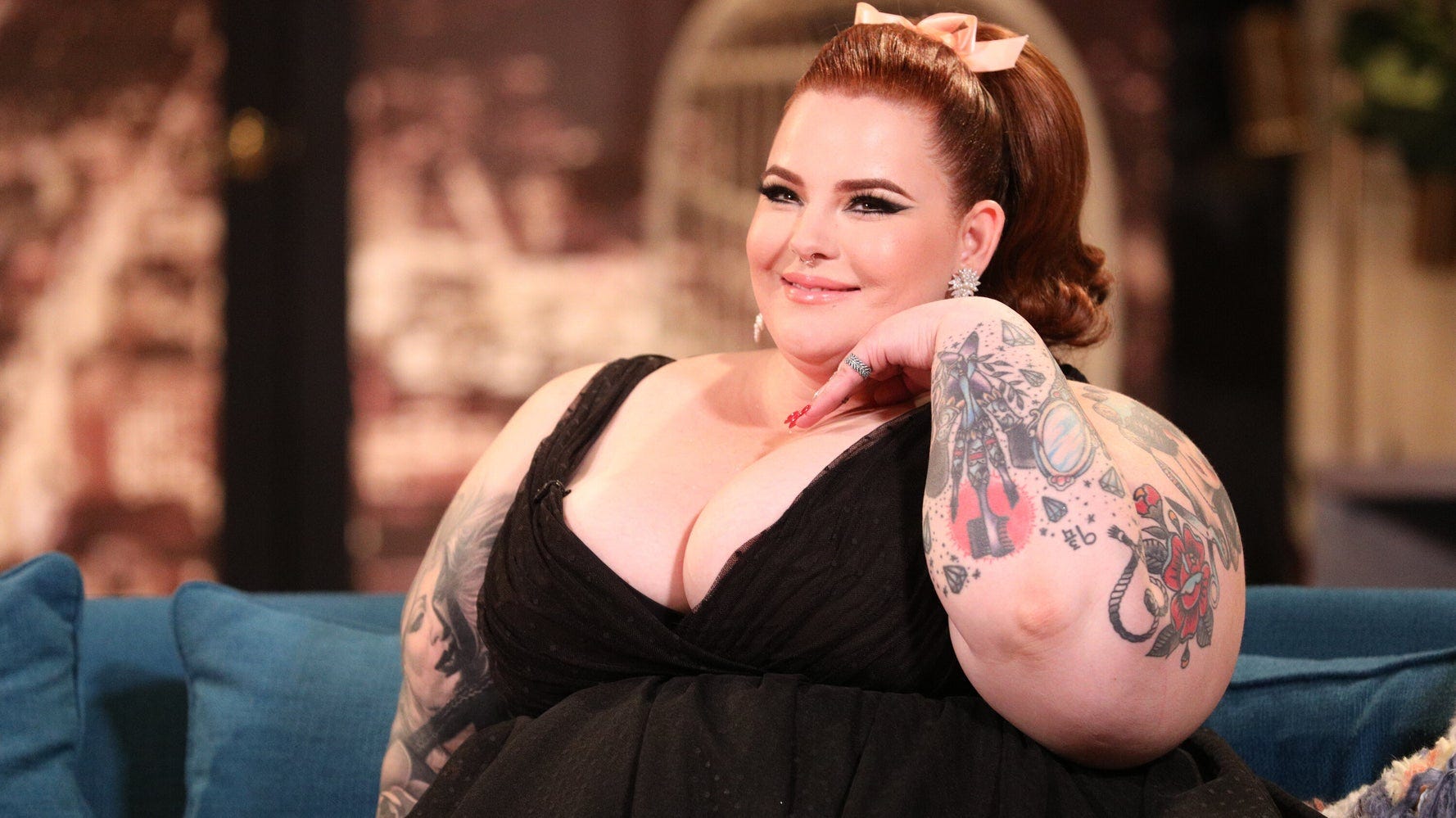
Feminists aren’t entirely wrong about fat. There are probably few women alive today in the west who have not compared their own bodies and faces to the beautiful images promoted everywhere on billboards, in movies, and in magazines. Many if not most women, from childhood well into our senior years, have a thin physical ideal we would like to attain and a precise understanding of where we fail to measure up.
Some women, through no fault of their own, have a particularly difficult time maintaining a good weight. Preoccupation with female bodily perfection can lead to debilitating eating disorders and fanatical exercising. And some people are indeed cruel to those who are obese (to men too, of course, but that’s another story that feminism ignores).
Where feminist theory fails is in its insistence that the grip of beauty standards is purely cultural, not natural. Feminists allege that beauty standards are designed to keep women small, powerless, and anxious—at war with themselves and full of shame.
Such analyses tend not to admit that strict standards apply also to male bodies and actions. The analyses also downplay the fact that there is no culture on earth that does not venerate the signs of youth and sexual fertility in the female sex.
Like most feminist postulates—and resulting in trans ideology and other extreme—fat acceptance seeks to deny that there is anything natural in our attitudes and desires about bodies. Nature itself, including men’s admiring response to female beauty and women’s desire to provoke it, is presented as destructive.
In its most extreme forms, feminism stresses that the basis of male-female attraction should be remade according to unnatural ideals in which the ugly is to be seen as beautiful, and vice versa.
How did feminist theory arrive at its fat mandate?
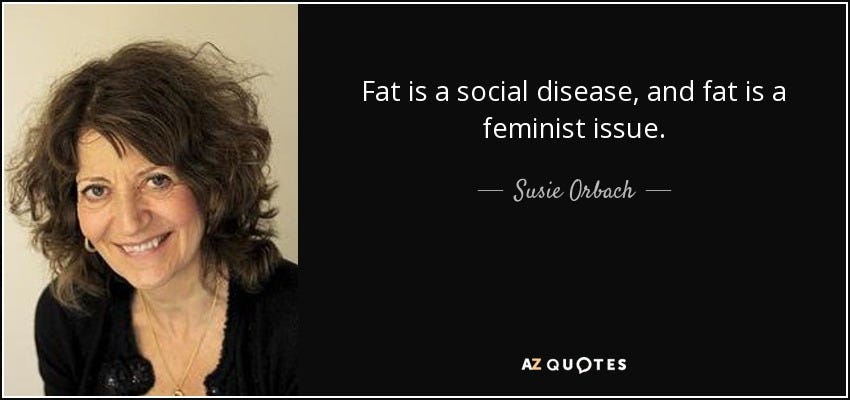
The modern feminist approach to fat began with British psychotherapist Susie Orbach’s blockbuster Fat is a Feminist Issue, published in 1978. It was a weight-loss book that promised to help women break their obsession with food and body size.
The book offered various psycho-social theories to explain the meaning of fat. It alleged that fat could function variously as self-protection (with fat as a type of armor against a sexually predatory world) or self-sabotage (with fat as a fallback to explain lack of success in love or career).
Where Orbach’s book was most feminist was in its blaming of patriarchy for making women fat. “Fat is a response,” she argued, “to the many oppressive manifestations of a sexist culture” (p. 21). Over-eating was a self-soothing reaction to women’s stress, powerlessness, and excessive service to others; it could also be a way of indirectly expressing anger in a society that did not readily allow women to do so.
According to Orbach’s therapeutic program, once the individual woman recognized that her fat could have political meaning, as a “protest against the inequality of the sexes” (p. 193), it became possible to understand her fat in more positive terms, seeing it as related to strength and integrity. She could then begin to find peace with her body, preparing the way for “life at a lower weight” (p. 156).
Feminists spent the next two decades refining ideas about how patriarchy imprinted itself on women’s bodies. The writings of Susan Bordo (1986), Sandra Lee Bartky (1988) and Naomi Wolf (1990), among others, diagnosed patriarchal expectations in everything from the way girls and women learned to move (or not move) in space, their reliance on diet regimes, high heels, or girdles to reshape their bodies, and their conformist use of makeup, anti-aging creams, hair-styling, body depilation, deodorant, feminine hygiene, breast implants, liposuction, Botox, and facial reconstruction.
According to feminist interpretation, the female body was the physical and psychological arena where forms of hetero-patriarchal power and resistance were enacted. Extending Orbach’s argument in a more radical direction, such critics increasingly began to see women’s refusal to conform to feminine ideals as a pro-feminist act of defiance.
Fat Is a Feminist Issue thus began to fall from favor because Orbach had accepted that losing weight was a worthy goal (the full title included The Anti-Diet Guide to Permanent Weight Loss). She had been clear that compulsive eating was not good for women either physically or psychologically.
The fat acceptance/fat liberation movement—and its more mainstream twin, body positivity—upended Orbach’s position. A review of Orbach in 2014 complained of the book: “I get that it was ‘groundbreaking,’ but when I read it all I hear is the same old fat-hatred/fat-blaming.” Another wrote, in 2018, “Do not read this book. It is outdated and will probably just make you feel worse about yourself and your body.” This reader rejected Orbach’s premise that “overeating and overweight” are “always intrinsically linked.”
By the turn of the 21st century, the connection between over-eating and being overweight was frequently denied. Fat advocates focused on weight stigma rather than weight itself. They stopped discussing fat women as unhappy people in need of therapy, instead portraying them as oppressed victims in need of liberation.
Bias against fat people—particularly against fat women—came to be seen not as a personal health matter but as a human rights issue.
This perspective took increasingly aggressive forms, both academic and popular.
Radical Fat Acceptance

Radical fat acceptance was the centerpiece of a 2016 academic article, “Scientific Weightism: A View of Mainstream Weight Stigma Research Through a Feminist Lens,” co-written by Rachel Calogero, Tracy Tylka, and Janell Mensinger. These were three American feminist academics with expertise in social psychology and health. Their article begins from the premise that stigma against obesity, rather than obesity itself, is the real problem.
The article adopts terms from other domains of social justice advocacy, using “thin privilege” to refer to the unearned advantages of those with a preferred body weight, and “weightist assumptions” to refer to false and bigoted ideas about weight, including the idea that weight has any causal relationship to health.
The authors go so far as to deny that there are any negative health consequences of obesity. They insist that although there are correlations between obesity and disease, correlation is not causation. They also deny that obesity is a condition within an individual’s power to control or modify. What can be controlled is the stigma.
“Weight stigma is a social justice issue,” the authors assert, “because people who are fat are denied their basic civil rights in every aspect of their lives, including their right to be fat and to live free of unfair treatment.” Merely to allege that obesity is harmful is an example of “unfair treatment” that the authors believe should be outlawed: “It is absolutely essential,” they conclude “that scholars campaign for formal legislation to protect against weight stigma and discrimination.”
Many popular discussions spread similar defiance. “Why is Fat a Feminist Issue?” by Gillian Brown argues that fat women experience discrimination because they unsettle the patriarchy: “Because we are seen as taking up more space than we should be, as being more bothersome than we should be, and as being uglier than we should be, fat women are an embodiment of exactly what patriarchal society does not want women to be: visible.”
Others went further to advocate for the sexual liberation of fat women, with Sydelle Barreto arguing, in “Fat and Forgotten: The Exclusion of Fat Women in Sexual Liberation and the Implications for Sexual Public Health,” that sexual prejudice against fat women is a significant form of misogynistic bigotry. “Liberation looks different when you are continually receiving the message that your body is less desirable and less valuable and that the decisions you make about your own body are less valid.”
“Why Fat is a Feminist Issue,” by Abigail Saguy, takes an intersectional approach to anti-fat sexual prejudice, claiming that black women and lesbians are better able than white heterosexual women to resist internalized fat phobia and less likely to judge other women. Saguy also claims that “there is evidence that dissatisfaction with body weight is a better predictor of health than actual weight.”
These and similar discussions, now ubiquitous on the internet, have exacerbated the accusatory resentment that feminism has fostered over the years. Fat women are encouraged to see themselves as in the vanguard of anti-patriarchal resistance while men who do not desire fat women are represented as bigots. Thin women are to feel (or at least to pretend) discomfort for conforming to oppressive body-ideals, with thin white heterosexual women particularly condemned.
Unhappy Women are Foot Soldiers for Feminism
Fat acceptance is a perfect outgrowth and amplification of feminism in its disruption of men and women’s natural attraction to one another.
Now a woman who wants to look pretty and shapely for men, or for one particular man, is told that she has internalized misogyny, while a man (or lesbian, for that matter) who prefers non-obese women is lectured about oppressive assumptions. White heterosexuals are targeted for accepting exclusionary body ideals more readily than others.
The ideology has significant real-world consequences that affect women’s longevity, quality of life, reproductive health, and emotional well being.
Ultimately, fat feminism lies to women by telling them they will be happier when they stop caring about their body size, reveling in their fat and forcing others to pretend to revel in it as well.
Alone at night, digging in to the second tub of ice cream and contemplating their excessive bulk, these women surely find the promised happiness to be illusory.
Enticing other women into the delusion—trapping them, too, into the cage of fat—may be their only, bitter, solace.